
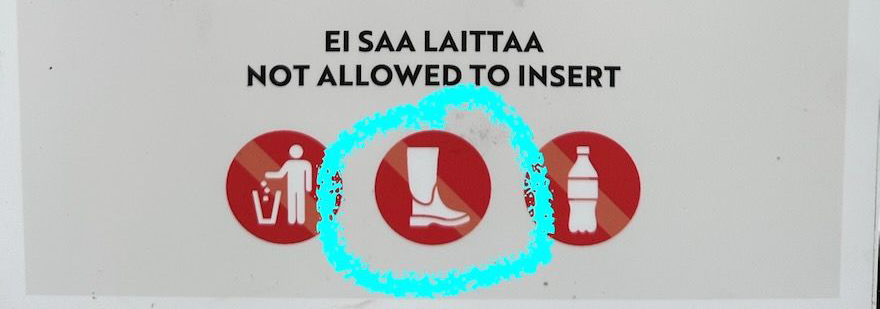
Will you please stop throwing your boots in the toilet?!
I found this sign at a composting toilet in a Finnish national park. It very specifically calls out what you can and cannot put in the toilet.
Apparently rubber boots are enough of a problem that they deserve their own prohibition symbol.
Which made me wonder: How often are people actually throwing boots in the toilet? Is this really a widespread issue? Or did it happen once or twice, and now there’s a permanent sign warning everyone about the dangers of toilet boots?

Some leadership teams do this exact same thing.
Someone behaves badly—consistently—and suddenly the team is writing norms to address it.
Here’s what this looks like in real life:
A leadership team is generally respectful with each other. They listen, they collaborate, they value different perspectives.
Except for one leader who doesn’t. They’re condescending in meetings. They dismiss others’ ideas. They don’t listen.
So when the team sits down to create team norms, someone suggests: “We should add something about treating each other with respect.”
Everyone nods. It gets added to the list.
And the disrespectful leader? They voice their displeasure. “This isn’t necessary. We’re all adults here.”
Here’s what just happened:
The team created a norm—like a sign on a composting toilet—to tell one person to stop doing what they shouldn’t be doing in the first place.
The other 95% of the team didn’t need that norm. They were already treating each other with respect.
But instead of addressing the one person’s behavior directly, the team built a system around it. Now everyone gets to read about respect in the team charter, even though only one person needed the message.
The cost of building for exceptions:
- Time – The real issue—the one leader’s behavior—never gets addressed, so it keeps resurfacing.
- Energy – The rest of the team is dancing around the one leader, obliquely pointing to the norms hoping the behavior will change.
- Morale – Trust collapses when poor behavior isn’t addressed directly.
Exception-based leadership is expensive. You’re spending resources managing around one person’s dysfunction instead of addressing it.
Just like that composting toilet sign, you can keep adding warnings and workarounds. But at some point, you have to ask: Why are we accepting boots in the toilet in the first place?
Stop building elaborate systems around bad behavior.
Either address the exception—clearly and directly—or accept that you’re designing your team for the person throwing boots in the toilet instead of the 95% doing things right.
Your team norms should serve the team, not protect the one person who won’t follow them.
Like this post? Want to see more? Connect with me on LinkedIn.
More about me and 110 West Group HERE.


Recent Comments